Agentic GraphRAG with Adaptive Graph Traversal for EPC Tendering
Technip Energies · Mar 2026 – Jul 2026 · Supervised by Julien Cadart
Context
Tendering for EPC (engineering, procurement, and construction) projects produces a large, multidisciplinary corpus: engineering, procurement, project management, legal, finance, insurance, and safety documents spanning about 40 specialised domains — from rotating equipment and piping to document control and risk management — in heterogeneous formats (PDF, Word, Excel, PowerPoint…).
Finding information across this corpus is manual, cross-checking is time-consuming, and critical information is easy to miss. The internship asked a concrete research question: can knowledge-graph-based retrieval improve the accuracy and completeness of the existing RAG system for large-scale engineering tender documents?
Contributions
- Domain-aware knowledge graph construction from a heterogeneous tender corpus
- An adaptive graph retrieval pipeline that picks a strategy based on the query
- Dual-Level RAG and Weighted Hub-aware PPR-RAG, combined with a cross-encoder reranker
- Quantitative and qualitative evaluation against a Hybrid RAG baseline
How the system works
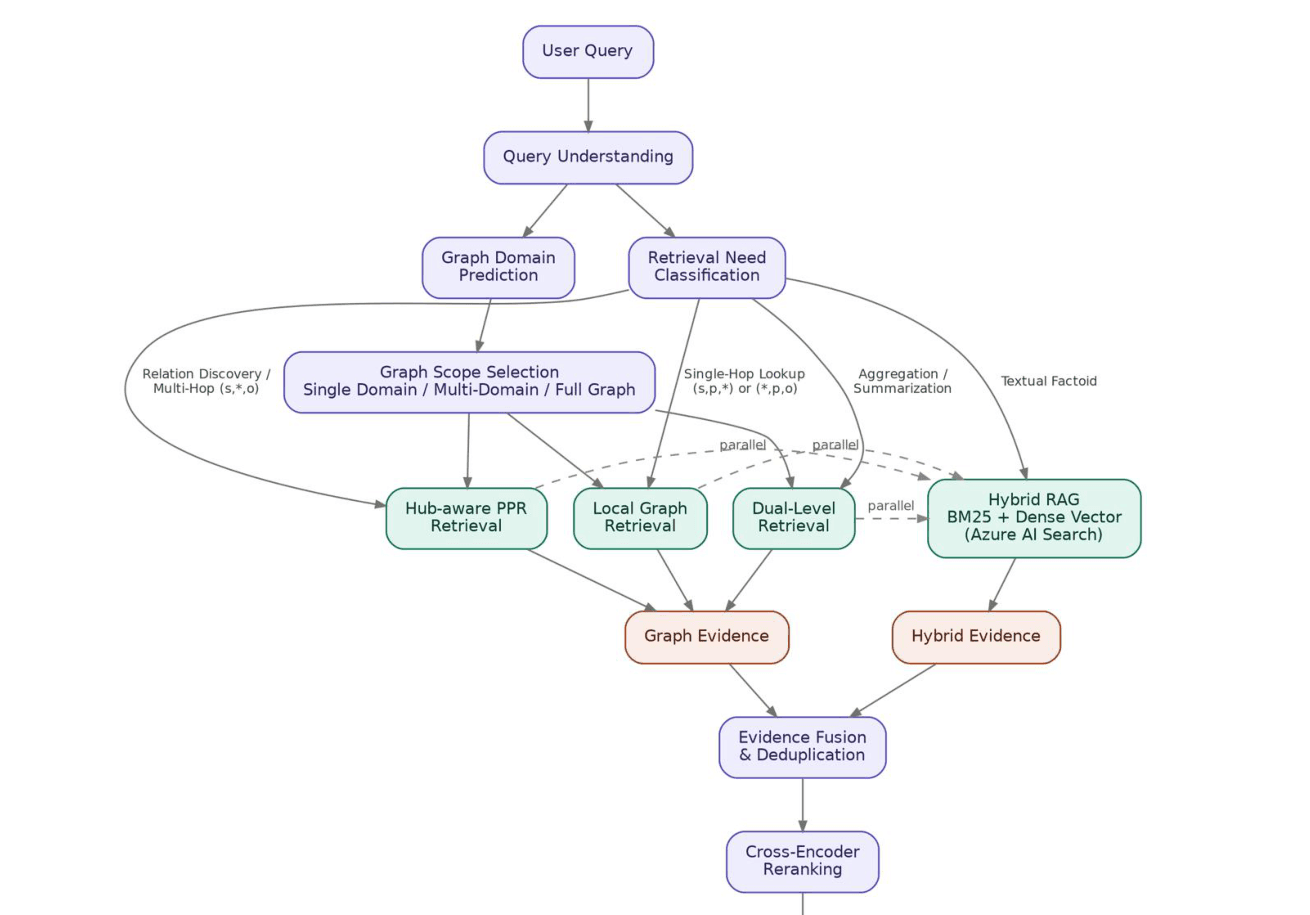
The pipeline builds a domain-aware knowledge graph from the tender corpus (free-form semantic relation extraction, constrained to entity types like deliverable, risk, requirement, project, and system), then answers queries in four stages:
- Query understanding. Each query is classified by retrieval need (textual factoid, single-hop lookup, aggregation/summarization, or relation discovery/multi-hop) and mapped to a graph scope: single domain, multi-domain, or full graph.
- Entity linking. Entities extracted from the query are matched to graph nodes with fuzzy matching and semantic search, fused via reciprocal rank fusion, then disambiguated and deduplicated by an LLM to produce seed entities.
- Adaptive retrieval. Based on the query type, the system routes to Hub-aware PPR retrieval, local graph retrieval, Dual-Level retrieval, or plain Hybrid RAG (BM25 + dense vectors on Azure AI Search) — avoiding expensive graph traversal when it isn't needed.
- Fusion and answering. Graph evidence and hybrid-search evidence are fused and deduplicated, reranked by a cross-encoder, and passed to an LLM for answer generation.
Results
Evaluation used 200 questions, an LLM-as-a-judge protocol, and a Hybrid RAG baseline (BM25 + dense vectors). Dual-Level RAG clearly improved summarisation and aggregation queries:
| Metric | Hybrid RAG | Dual-Level RAG |
|---|---|---|
| Accuracy | 0.840 | 0.965 |
| Completeness | 0.794 | 0.882 |
| Relevance | 0.930 | 0.988 |
| Context precision | 0.824 | 0.857 |
| Latency | 20 s | 31 s |
For relational and multi-hop queries, Weighted Hub-aware PPR-RAG brought smaller, not clearly significant gains — at almost double the latency:
| Metric | Hybrid RAG | PPR-RAG |
|---|---|---|
| Accuracy | 0.875 | 0.882 |
| Completeness | 0.850 | 0.862 |
| Relevance | 0.905 | 0.951 |
| Context precision | 0.805 | 0.841 |
| Latency | 21 s | 37 s |
Limitations
Failure analysis pointed to the graph itself: the constructed knowledge graph had 3,921 connected components, and 75.2% of them contained five nodes or fewer. Most entities were isolated or lived in tiny neighbourhoods, so Personalized PageRank could not propagate across disconnected components. Imperfect entity resolution (acronyms, aliases, inconsistent terminology) was a major cause of that fragmentation.
Takeaway
Knowledge graphs improve information aggregation over plain Hybrid RAG, and graph retrieval and hybrid retrieval are complementary rather than competing. But reliable multi-hop retrieval requires a cleaner, better-connected graph — pointing to future work on ontology refinement, entity resolution (acronym and alias normalisation, merging semantically equivalent entities), a gold-standard question–answer benchmark, and evaluation on other EPC tenders.